Ratio Calculator
Divide both numbers in 12:18 by 6 to get 2:3. Try your own ratio, split a total between two or more shares, or enter a proportion such as 6:8 = 15:? to find the missing number.
Your result
Simplify a pair or find a missing ratio term
Enter a pair such as 2 to 1, 4:1 or 2 3 to load the main Simplify calculator. For a proportion, enter A:B = C:D and replace any one of the four terms with a question mark.
For example, ?:8 = 15:20 gives A = 6 because 8 × 15 ÷ 20 = 6.
Compare two ratios
Are A:B and C:D equivalent? Enter both ratios in the same order. Use matching units for A and C, and for B and D.
How to check equivalent ratios
Multiply A by D and B by C. If the two products match, the ratios are equivalent. For 12:8 and 30:20, both 12 × 20 and 8 × 30 equal 240. Change the second ratio to 30:21 and the products become 252 and 240, so the ratios differ.
Simplify a ratio with three or more terms
For a ratio such as 6:9:15, reduce every term by the same greatest common divisor. You can also split a total among all the parts. Use comparable units; convert kilograms and grams before comparing them.
Worked three-term example
6:9:15 simplifies to 2:3:5. There are 2 + 3 + 5 = 10 equal parts. A total of 120 gives 12 per part, so the allocations are 24, 36 and 60. The corresponding shares are 1/5, 3/10 and 1/2: approximately 20%, 30% and 50%.
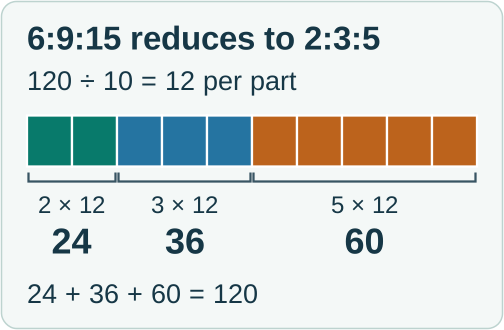
Each positive ratio term and the optional nonnegative total supports up to six decimal places. Reduction, share fractions and allocation fractions use exact integer arithmetic. Percentages and decimal allocations are approximate; independently rounded amounts may not add exactly to the total. Zero ratio terms, negative terms, fractions written with a slash and scientific notation are not supported.
How to simplify a two-term ratio
8:12 simplifies to 2:3 because both terms divide by 4. To split 50 in that ratio, divide 50 into five equal parts of 10. The two shares are 20 and 30. The calculator also simplifies positive decimal ratios and finds the missing value in A:B = C:D.
Choose the ratio question you need to answer
- Enter the first ratio term A and second term B in comparable units. Each must be positive and have no more than six decimal places.
- Choose simplify to reduce A:B. Choose split a total when you know the combined amount A and B must share. Choose find D when C corresponds to the first term A in an equivalent proportion.
- Read the exact share fractions separately from A/B. For 3:2, A/B is 1.5, but A is 3/5 or 60% of the combined whole.
- Load one of the examples to check decimal reduction, total allocation or a 16:9 dimension proportion. Display rounding can make the shown allocations sum slightly differently from the original total.
How the calculation works
Simplification multiplies each accepted decimal by 10^6 and divides the integer pair by their greatest common divisor. To split total T, first = T × A/(A+B), second = T × B/(A+B). For A:B = C:D, D = C × B/A.
Worked example
3:2 has five total parts. Splitting 100 gives A = 100 × 3/5 = 60 and B = 100 × 2/5 = 40. A/B is 1.5, not 60%. For a different task, 16:9 = 1920:D gives D = 1920 × 9 / 16 = 1080; 1920 is the new first dimension, not the sum of both dimensions.
Ratio practice: six questions and a worked answer key
Try the questions on paper first, then use the calculator to check your reasoning. The answer key explains the distinction between comparing two parts and finding a share of a whole. Follow your course rules on calculator use.
Download the PDF pack for two A4 pages: questions first, then worked answers. Keep the answer page separate when practising.
Each SVG download is one A4 sheet. Open the SVG in a browser to print; use fit-to-page if your printer needs margins. The same questions and answers are available as text below.
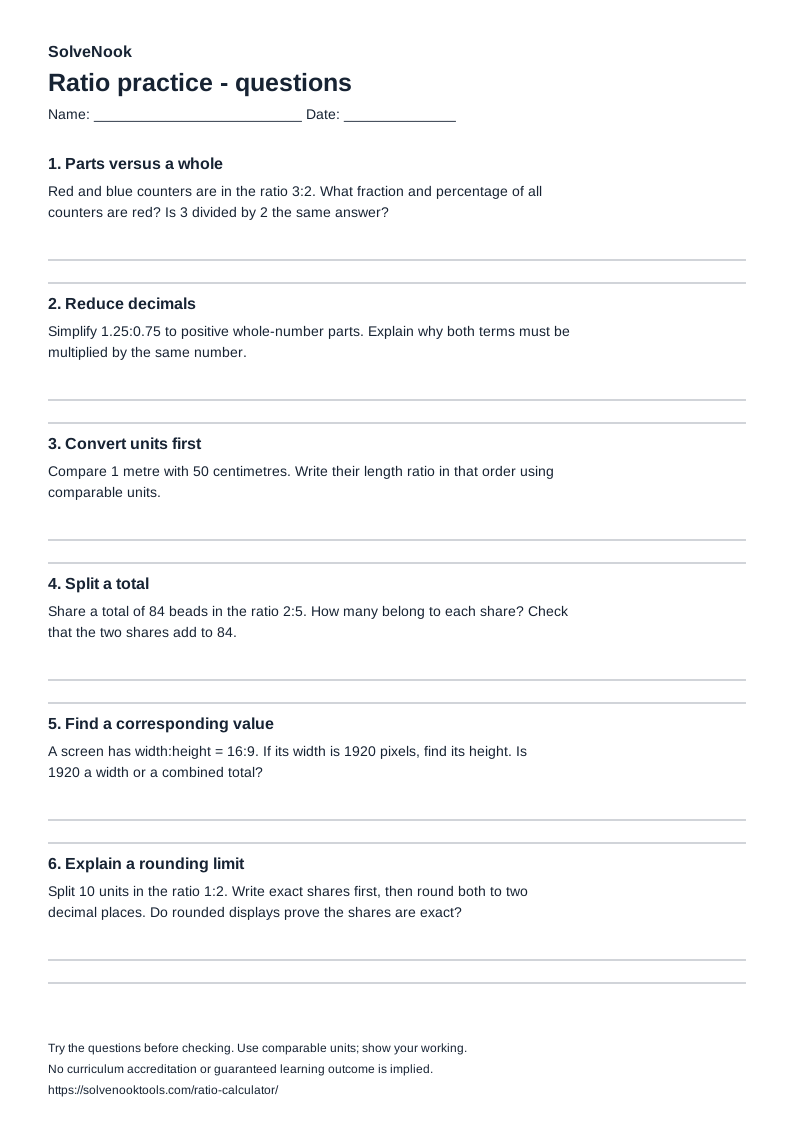
Preview the worked answer sheet
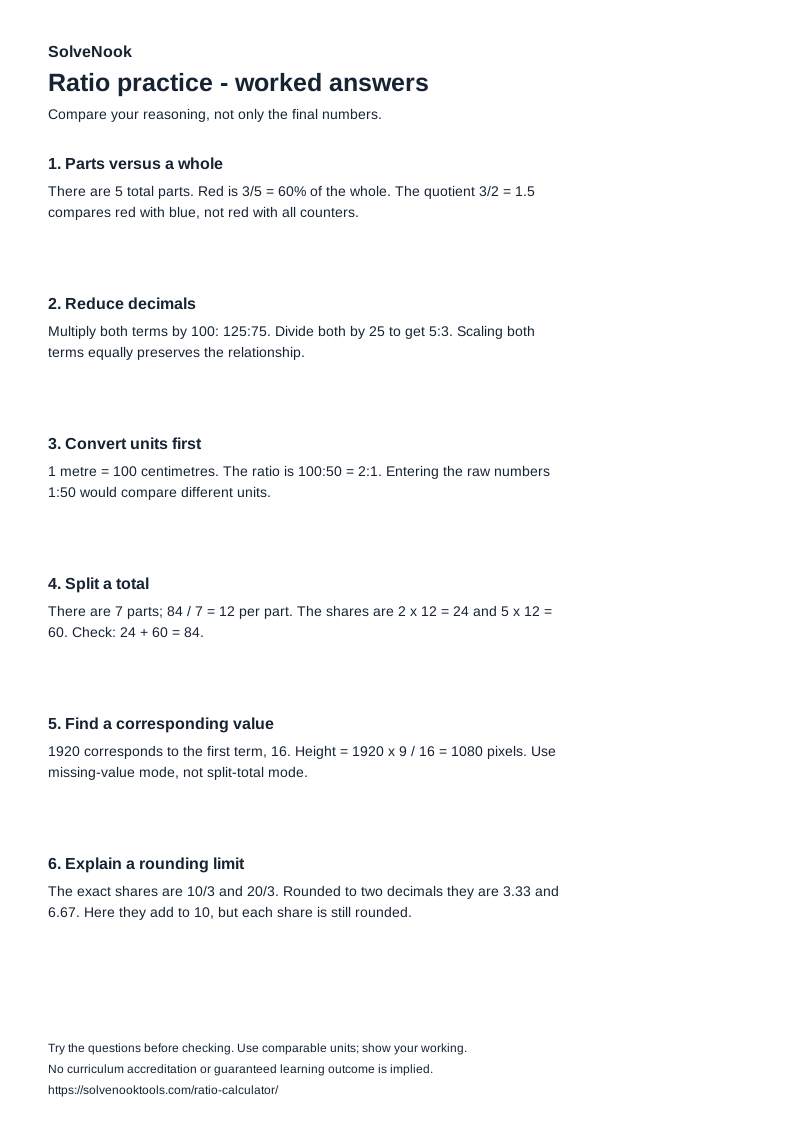
Parts versus a whole
Red and blue counters are in the ratio 3:2. What fraction and percentage of all counters are red? Is 3 divided by 2 the same answer?
Show worked answer: parts versus a whole
There are 5 total parts. Red is 3/5 = 60% of the whole. The quotient 3/2 = 1.5 compares red with blue, not red with all counters.
Reduce decimals
Simplify 1.25:0.75 to positive whole-number parts. Explain why both terms must be multiplied by the same number.
Show worked answer: reduce decimals
Multiply both terms by 100: 125:75. Divide both by 25 to get 5:3. Scaling both terms equally preserves the relationship.
Convert units first
Compare 1 metre with 50 centimetres. Write their length ratio in that order using comparable units.
Show worked answer: convert units first
1 metre = 100 centimetres. The ratio is 100:50 = 2:1. Entering the raw numbers 1:50 would compare different units.
Split a total
Share a total of 84 beads in the ratio 2:5. How many belong to each share? Check that the two shares add to 84.
Show worked answer: split a total
There are 7 parts; 84 / 7 = 12 per part. The shares are 2 x 12 = 24 and 5 x 12 = 60. Check: 24 + 60 = 84.
Find a corresponding value
A screen has width:height = 16:9. If its width is 1920 pixels, find its height. Is 1920 a width or a combined total?
Show worked answer: find a corresponding value
1920 corresponds to the first term, 16. Height = 1920 x 9 / 16 = 1080 pixels. Use missing-value mode, not split-total mode.
Explain a rounding limit
Split 10 units in the ratio 1:2. Write exact shares first, then round both to two decimal places. Do rounded displays prove the shares are exact?
Show worked answer: explain a rounding limit
The exact shares are 10/3 and 20/3. Rounded to two decimals they are 3.33 and 6.67. Here they add to 10, but each share is still rounded.
Ratio, quotient and share answer different questions
| Quantity | Calculation | Meaning |
|---|---|---|
| Part-to-part ratio | 3:2 | Three A parts for every two B parts |
| A compared with B | 3 / 2 = 1.5 | A is 1.5 times B, or 150% of B |
| A share of total | 3 / (3+2) = 3/5 = 0.6 = 60% | A receives 60% of the combined whole |
| B share of total | 2 / (3+2) = 2/5 = 0.4 = 40% | B receives the remaining 40% |
Make an equivalent ratio table
After calculating, read ten whole-number multiples of the simplified ratio. For 1.25:0.75, the simplest ratio is 5:3: multipliers 1, 2 and 3 give 5:3, 10:6 and 15:9. Multiply both terms by the same factor; adding the same number to both usually changes the ratio.
The A + B column adds the two terms in that row. It is not the total entered in split-total mode. For example, a 3:2 table starts at 3 and 2 with a sum of 5; splitting a separate total of 100 still gives 60 and 40. Table values use exact integer arithmetic and stay separate from rounded allocation results.
Why unit conversion comes before the ratio
A ratio is meaningful only after the terms describe comparable quantities or an explicitly defined rate. Comparing 1 metre with 50 centimetres as raw 1:50 gives the wrong length ratio. Convert both to centimetres first: 100:50 reduces to 2:1. This calculator does not convert units automatically.
The two terms must remain in the same order. Swapping A and B reverses the comparison and swaps their shares. In missing-value mode, C must correspond to A; entering a combined total in C asks a different question.
Exact reduction and rounded allocation are separate
Accepted A and B decimals are multiplied by one million, then reduced using integer greatest-common-divisor arithmetic. Share fractions use the resulting exact integer parts. Quotients, percentages and allocations use browser floating-point arithmetic and display rounding. Numeric form fields may lose low-order decimal digits at very large magnitudes; exact reduction applies to the values the engine receives, not digits already lost during input conversion.
Small nonzero displayed values use scientific notation instead of silently appearing as zero. Zero ratio terms remain outside this model; zero entered totals and zero C are allowed. A bar shows proportions even when both selected quantities are zero, and extreme proportions may create a segment too narrow to see. The fraction labels provide the numerical meaning.
Assumptions and limitations
A and B must be positive comparable quantities. Decimal simplification supports at most six decimal places and uses exact integer reduction. Scaling outputs use browser floating-point arithmetic. Convert differing units before entering them.
For a 16:9 aspect ratio, enter A=16, B=9; use missing mode with C as the new width. For a recipe ratio, use one consistent mass or volume unit. A zero total can be split, but zero ratio terms are outside this model.
Sources and editorial responsibility
Maintained by Renvoro Pty Ltd. Sources inform the methods and assumptions shown here; outputs have the limitations described on this page.
Guide updated 2026-11-10. Calculation method and source dates remain separate.
Method reviewed 2026-10-23. Calculation standards · Report an issue